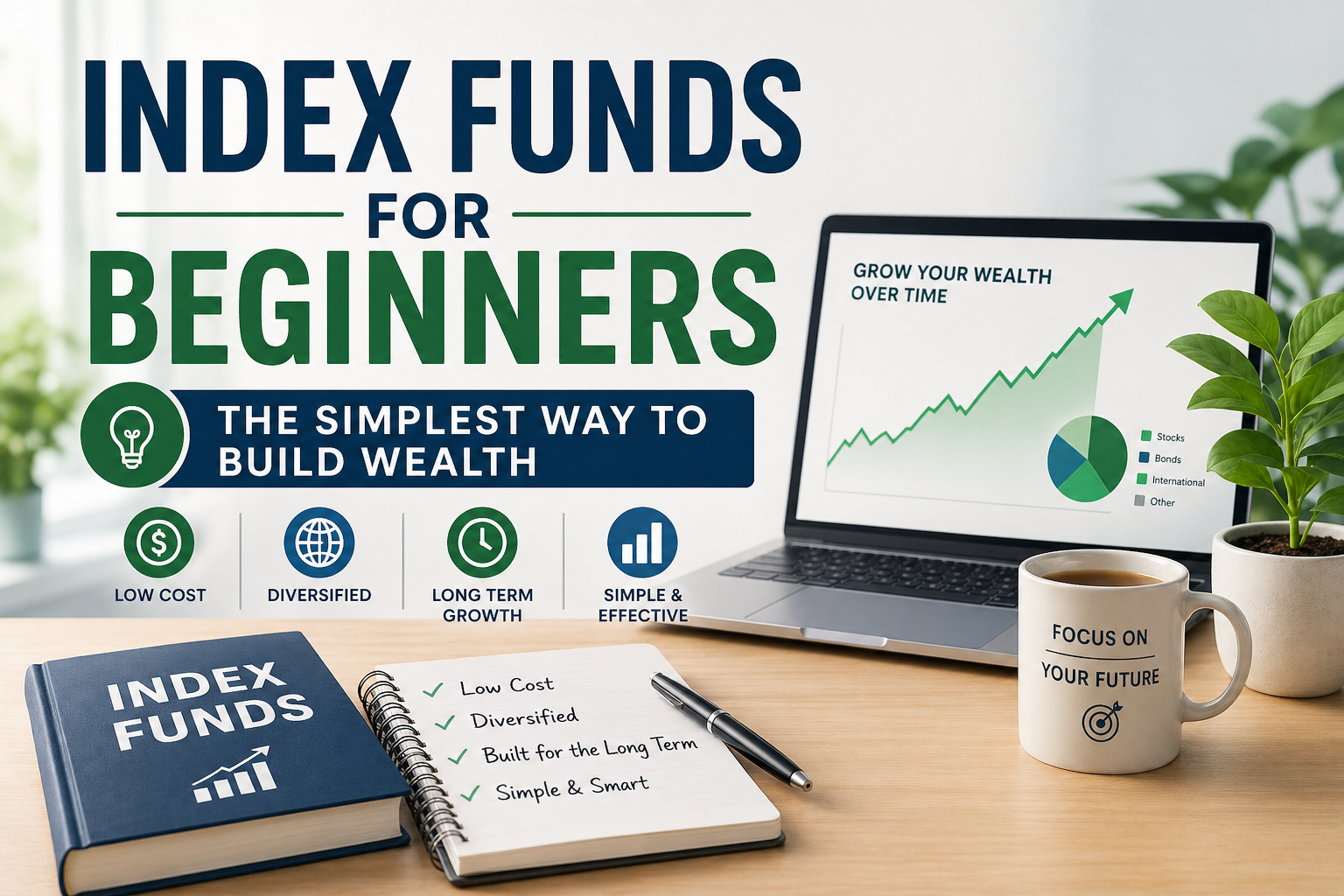
Index Funds for Beginners: The Simplest Way to Build Wealth in 2026

Rachel Kim
Certified Financial Planner (CFP) · 11+ years in personal finance & index investing
Reviewed by David Osei, CFA, Portfolio Strategist.
Last updated:
📊 Data-Backed
⏱ 13 min read
🔄 Updated April 2026
If you’ve ever wondered how to grow your money without needing a finance degree or thousands of dollars to start, index funds for beginners are the answer. Backed by decades of data, championed by investing legends like Warren Buffett, and accessible to anyone with a smartphone and a few dollars — index funds have quietly become the most powerful wealth-building tool available to everyday investors. In this guide, you’ll learn exactly what index funds are, how to invest in them, the best options in 2026, and how to avoid the common mistakes that derail most first-time investors.
🎯 Key Takeaways
- Index funds track a market index like the S&P 500, giving you automatic diversification across hundreds of companies with a single purchase.
- Over 15 years, approximately 92% of actively managed large-cap funds underperformed their benchmark index, according to the S&P SPIVA report.
- You can start investing in index funds with as little as $1 using fractional shares at brokerages like Fidelity or Charles Schwab.
- The biggest advantage is the low expense ratio — top index funds charge as little as 0.03% annually versus 1–2% for actively managed funds.
📖 Real Story
Meet Priya Sharma, a 28-year-old software developer from Bengaluru, India. In 2023, she was earning well but had no investments — every rupee sat in a savings account earning 3.5% interest while inflation quietly ate her purchasing power. She’d tried researching stocks but felt overwhelmed by the jargon, the risks, and the sheer number of choices. “I didn’t want to become a full-time trader,” she told me. “I just wanted my money to grow while I focused on my job.” After a colleague mentioned index funds at lunch, Priya spent one weekend learning the basics. She opened a brokerage account, set up a recurring monthly SIP of ₹10,000 into a Nifty 50 index fund, and has not touched it since. Two and a half years later, her portfolio has grown by over 34%, and she contributes without thinking twice. “It’s the only financial decision I’ve made that I’ve never regretted,” she says. Her story is not unique — it’s what happens when you stop overthinking and start investing simply.
What Is an Index Fund? (index funds for beginners)
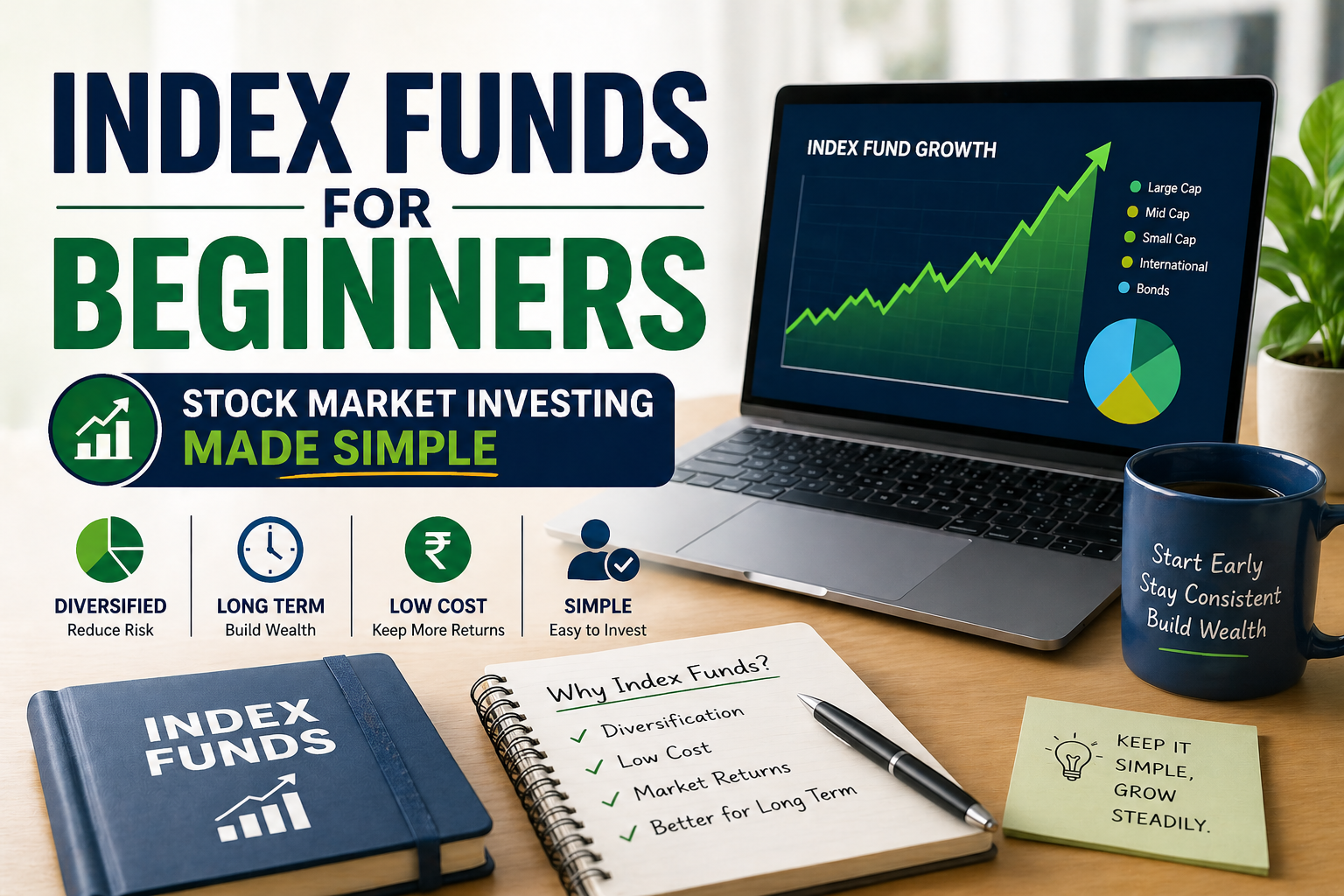
An index fund is a type of investment fund — either a mutual fund or an exchange-traded fund (ETF) — designed to replicate the performance of a specific market index. A market index is essentially a list of stocks chosen to represent a portion of the financial market. The most well-known is the S&P 500, which tracks 500 of the largest publicly listed companies in the United States.
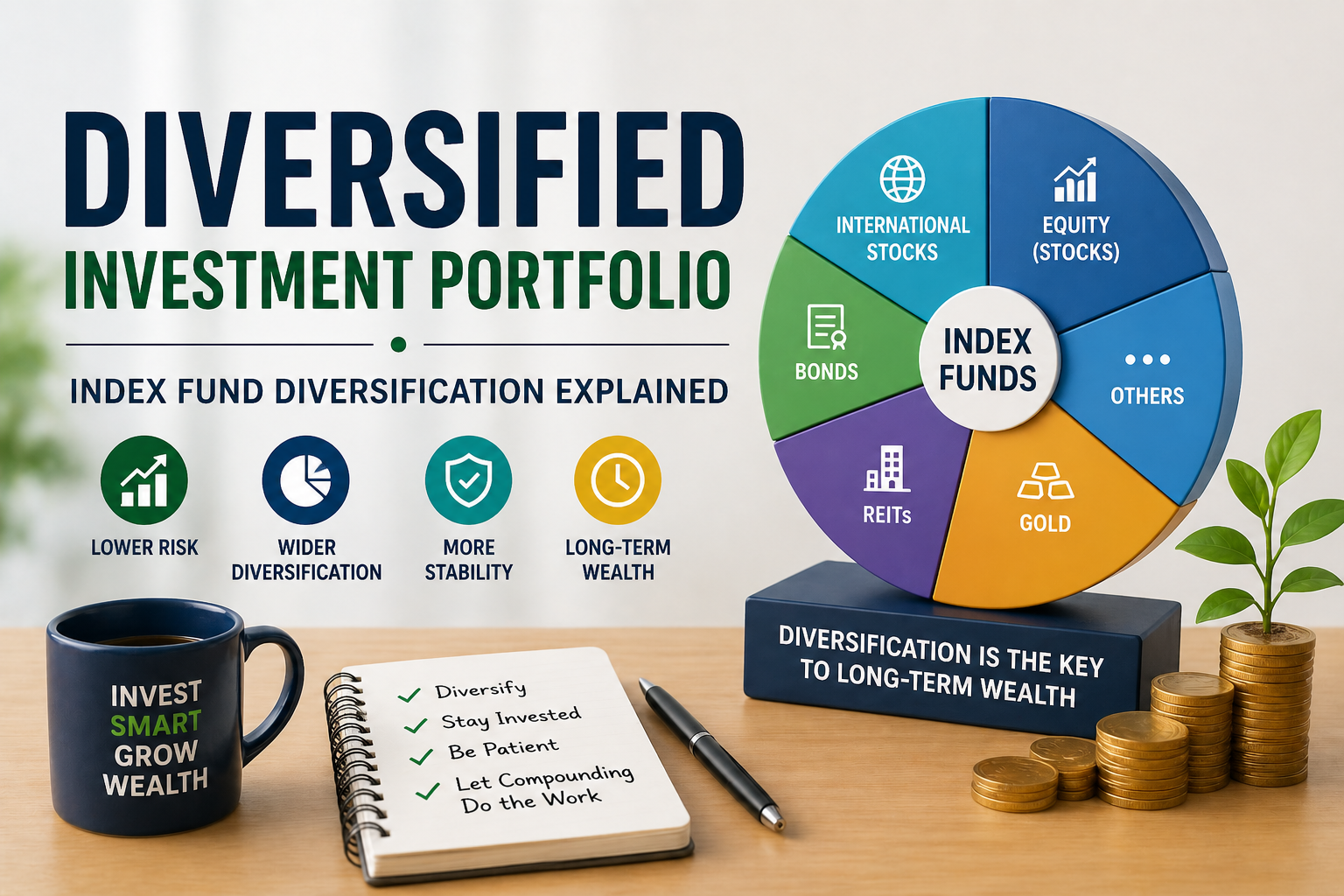
When you buy into an S&P 500 index fund, you are effectively buying tiny slices of all 500 companies — from Apple and Microsoft to JPMorgan and Walmart — in a single transaction. This is the core magic of index investing: instant, effortless diversification. Instead of betting on one or two companies, your risk is spread across hundreds.
Index funds are passively managed, which means there is no highly paid fund manager actively picking stocks. The fund simply holds whatever is in the index, rebalancing only when the index itself changes. This passive approach is the key reason index funds are so affordable. According to Investopedia’s expense ratio guide, the average index fund expense ratio is around 0.06%, compared to 0.66% or higher for actively managed funds. Over decades, this cost difference compounds into tens of thousands of dollars saved.
Warren Buffett, one of the greatest investors of all time, has repeatedly stated that most investors — including professional ones — would be better off putting their money in a low-cost S&P 500 index fund rather than picking individual stocks or hiring active managers. In his 2013 shareholder letter, he even stipulated that the trustee managing his estate should invest 90% of the remaining cash in an S&P 500 index fund.
The historical performance makes a compelling case. According to data from S&P Global’s SPIVA report, over a 15-year period, approximately 92% of actively managed large-cap funds failed to outperform the S&P 500 index. That means the vast majority of professional stock pickers — with their armies of analysts and billions in resources — cannot consistently beat a simple index fund. For a beginner with no time, no market expertise, and no interest in daily trading, this data is extremely liberating.
Ultra-Low Costs
Expense ratios as low as 0.03% mean more of your money stays invested and compounding.
Instant Diversification
One fund purchase gives you exposure to hundreds or thousands of companies.
Hands-Off Investing
No research, no stock-picking, no daily monitoring required. Set it and forget it.
Proven Track Record
The S&P 500 has historically returned an average of around 10% per year over the long term.
How to Invest in Index Funds: Step-by-Step Guide
The process of investing in index funds is far simpler than most people imagine. You do not need a broker or a financial advisor to get started. Here is a clear, actionable roadmap from zero to your first investment.
Step 1: Define Your Financial Goal
Before you invest a single dollar, know why you are investing. Are you building a retirement nest egg? Saving for a home down payment? Growing a general emergency fund? Your investment horizon — the length of time before you’ll need the money — is the most important factor in choosing the right index fund. For long-term goals (10+ years), broad stock market index funds are ideal. For shorter timelines (3–5 years), a bond index fund or balanced fund may be more appropriate since they experience less dramatic swings.
Step 2: Choose a Brokerage Account
You need a brokerage account to buy index funds. In the United States, top beginner-friendly platforms include Fidelity, Charles Schwab, and Vanguard. In India, platforms like Zerodha, Groww, and Paytm Money offer direct index fund and ETF investing with minimal fees. In the UK, platforms like Vanguard UK and Hargreaves Lansdown are popular. Look for zero-commission trades, no account minimums, and a strong mobile app experience. Opening an account typically takes under 15 minutes and requires only basic identity verification documents.
Step 3: Select Your Index Fund
The most beginner-friendly choice is a broad market index fund that tracks the entire stock market or a major index like the S&P 500. When comparing funds, the most critical factor is the expense ratio — the annual percentage fee charged by the fund. Two funds tracking the exact same index can have vastly different expense ratios. Always choose the lowest-cost option. A difference of just 0.5% in fees may seem small, but compounded over 30 years it can equate to tens of thousands of dollars in lost returns.
Step 4: Decide How Much to Invest
Start with whatever amount you can commit to consistently. Consistency beats timing. Many index funds — particularly ETFs — allow fractional share investing, meaning you can start with as little as $1 or ₹100. A better approach than saving up a large lump sum is dollar-cost averaging: investing a fixed amount at regular intervals (monthly or weekly). This strategy automatically means you buy more shares when prices are low and fewer when prices are high, reducing the risk of investing everything right before a market dip.
Step 5: Buy the Index Fund
Log into your brokerage, search for your chosen fund by its ticker symbol (e.g., VOO for Vanguard S&P 500 ETF), and place a buy order. For ETFs, you’ll see a real-time price just like a stock. For mutual fund index funds, orders execute at the end of the trading day at the fund’s net asset value (NAV). Set up automatic recurring investments through your brokerage’s “auto-invest” feature so contributions happen without you having to remember.
Step 6: Review and Stay the Course
Once invested, check your portfolio no more than once a month — and ideally just once a quarter. The biggest mistake new investors make is reacting to short-term market fluctuations. Index funds are long-term vehicles. Market dips are not emergencies; they are opportunities for your recurring contributions to buy more shares at a discount. Rebalance your portfolio once a year if your allocation has drifted significantly from your target.
If your employer offers a 401(k) or similar retirement plan with index fund options, always contribute enough to claim the full employer match before investing elsewhere. A 100% employer match is an instant 100% return — no index fund in the world can beat that.
🔗 You Might Also Like
Index Fund vs Mutual Fund: Which Should You Choose?
The terms “index fund” and “mutual fund” are often used interchangeably, but they are not the same thing. An index fund is a type of mutual fund — but not all mutual funds are index funds. The critical distinction lies in how each is managed and what that means for your returns. Below is a detailed comparison to help you understand index fund vs mutual fund differences.
| Feature | Index Fund | Actively Managed Mutual Fund |
|---|---|---|
| Management Style | Passive — tracks an index automatically | Active — fund manager picks stocks |
| Expense Ratio | Very low: 0.03%–0.20% | High: 0.50%–2.0% or more |
| Long-Term Performance | Matches market returns reliably | 92% underperform index over 15 years |
| Tax Efficiency | High — minimal buying and selling | Lower — frequent trades create taxable events |
| Transparency | Full — you know exactly what you own | Partial — holdings disclosed quarterly |
| Minimum Investment | As low as $1 (ETFs with fractional shares) | Often $1,000–$3,000 minimum |
| Best For | Long-term, passive, buy-and-hold investors | Specific niche strategies or sectors |
For the vast majority of beginners, index funds win on every measurable metric: lower cost, better long-term average performance, simpler decision-making, and higher tax efficiency. The only scenario where an actively managed fund might make sense is for very specific niche strategies — for example, a specialized emerging market fund that an index does not cover. But for core, foundational portfolio building, passive index investing is the superior approach. This is not a fringe opinion; it is the consensus view of Vanguard, Morningstar, and most academic finance research.
🧮 Try Our Free Index Fund Returns Calculator
Estimate how your money could grow with consistent index fund investing
$400
20 years
9.0%
0.03%
Best Index Funds 2026: Top Picks for Beginners
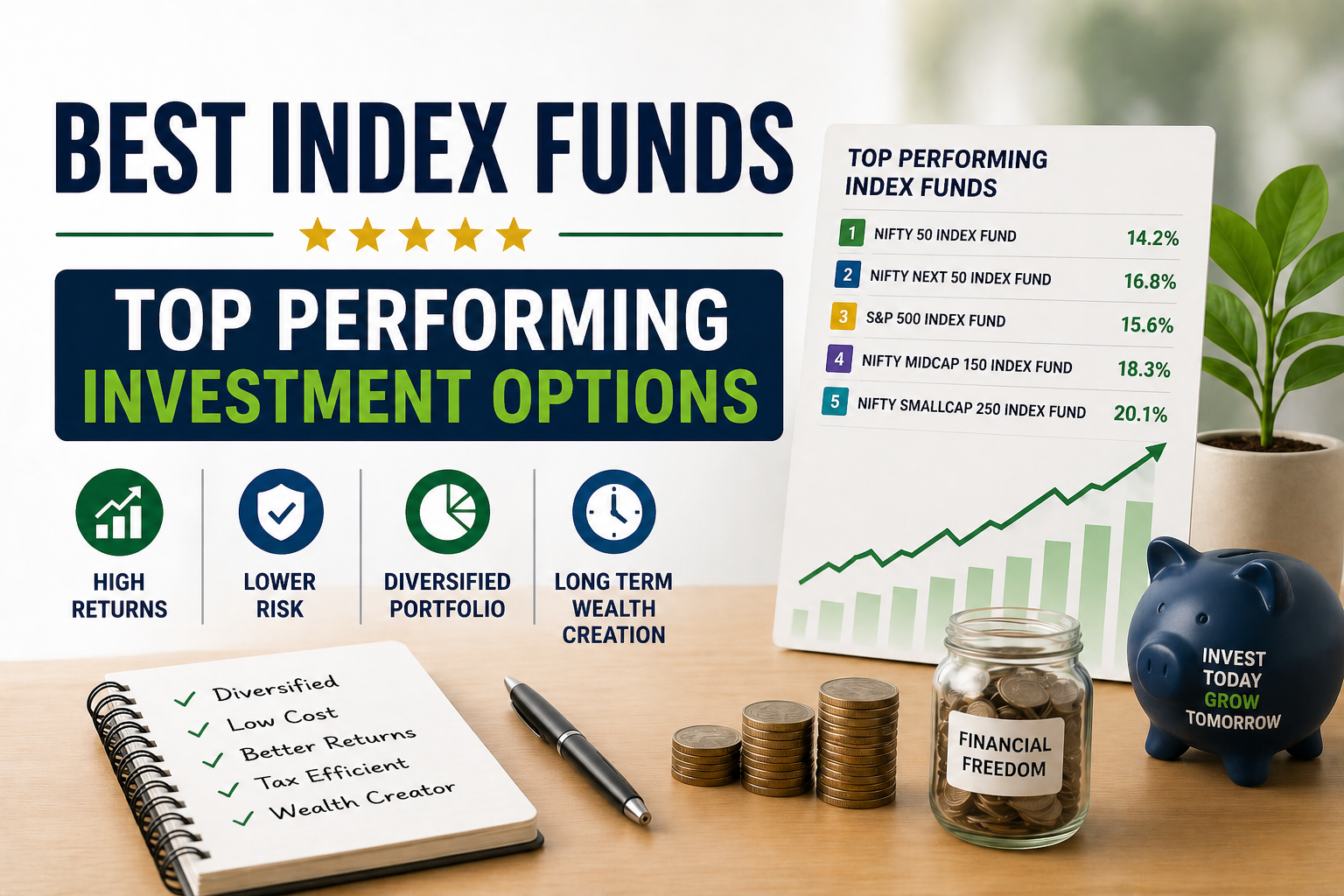
With thousands of index funds available globally, narrowing your first choice can be daunting. The best index funds in 2026 for beginners share three characteristics: an extremely low expense ratio, broad diversification across hundreds of securities, and a long performance track record with a reputable fund house. Here are the top recommendations across major markets.
🇺🇸 United States — Best Index Funds
| Fund Name | Ticker | Expense Ratio | What It Tracks |
|---|---|---|---|
| Vanguard S&P 500 ETF | VOO | 0.03% | S&P 500 (500 large US companies) |
| Fidelity Zero Total Market | FZROX | 0.00% | US total stock market (~2,700 companies) |
| Schwab Total Stock Market | SWTSX | 0.03% | Dow Jones US total market |
| iShares Core MSCI World ETF | URTH | 0.24% | MSCI World Index (23 developed countries) |
🇮🇳 India — Best Index Funds
| Fund Name | Expense Ratio | What It Tracks | Min SIP |
|---|---|---|---|
| UTI Nifty 50 Index Fund | 0.20% | Nifty 50 (top 50 NSE companies) | ₹500/month |
| Nippon India Nifty 500 Momentum | 0.30% | Nifty 500 Momentum 50 Index | ₹100/month |
| HDFC Nifty Next 50 Index | 0.30% | Nifty Next 50 (companies 51–100) | ₹500/month |
When selecting an index fund, always compare the “tracking error” — how closely the fund follows its benchmark index. A lower tracking error means the fund is more faithfully replicating the index it is supposed to track. Look for funds with a tracking error under 0.5%.
Common Mistakes Beginners Make (And How to Avoid Them)
Index funds are beautifully simple — but that simplicity does not make them foolproof. Behavioral mistakes, not poor fund selection, are the number one reason beginner investors underperform. A 2021 study by DALBAR found that the average equity investor earned 7.13% annually over 30 years, compared to 10.65% for the S&P 500 — a gap caused almost entirely by poor timing decisions and emotional reactions to market volatility. Here are the most common mistakes and how to sidestep them.
When the market drops 20%, your gut screams to sell. But index fund investing requires the exact opposite reaction. Market corrections are temporary; the long-term trend of broad markets has always been upward. Selling during a dip locks in your losses permanently and means you likely miss the subsequent recovery. Stay invested. Your time in the market matters more than timing the market.
A sector-specific fund that returned 40% last year looks irresistible. But past performance does not predict future returns. In fact, last year’s top-performing sectors often mean-revert to average or below-average performance the following year. Beginners are better served by broad, diversified market index funds rather than narrow sector bets.
Before investing in a taxable brokerage account, maximize contributions to tax-advantaged retirement accounts like a 401(k), Roth IRA (US), ISA (UK), PPF or NPS (India). Investing your index fund inside a tax-sheltered account means you pay no capital gains tax on growth, which can add up to an enormous difference over decades. Always fill your tax-advantaged buckets first.
Owning 15 different index funds does not make you safer — it makes your portfolio redundant and harder to manage. A simple three-fund portfolio (domestic stocks, international stocks, and bonds) is sufficient for most investors. More complexity rarely adds proportional benefit and often increases costs.
Real-World Case Study: From $0 to $100,000 With Index Funds
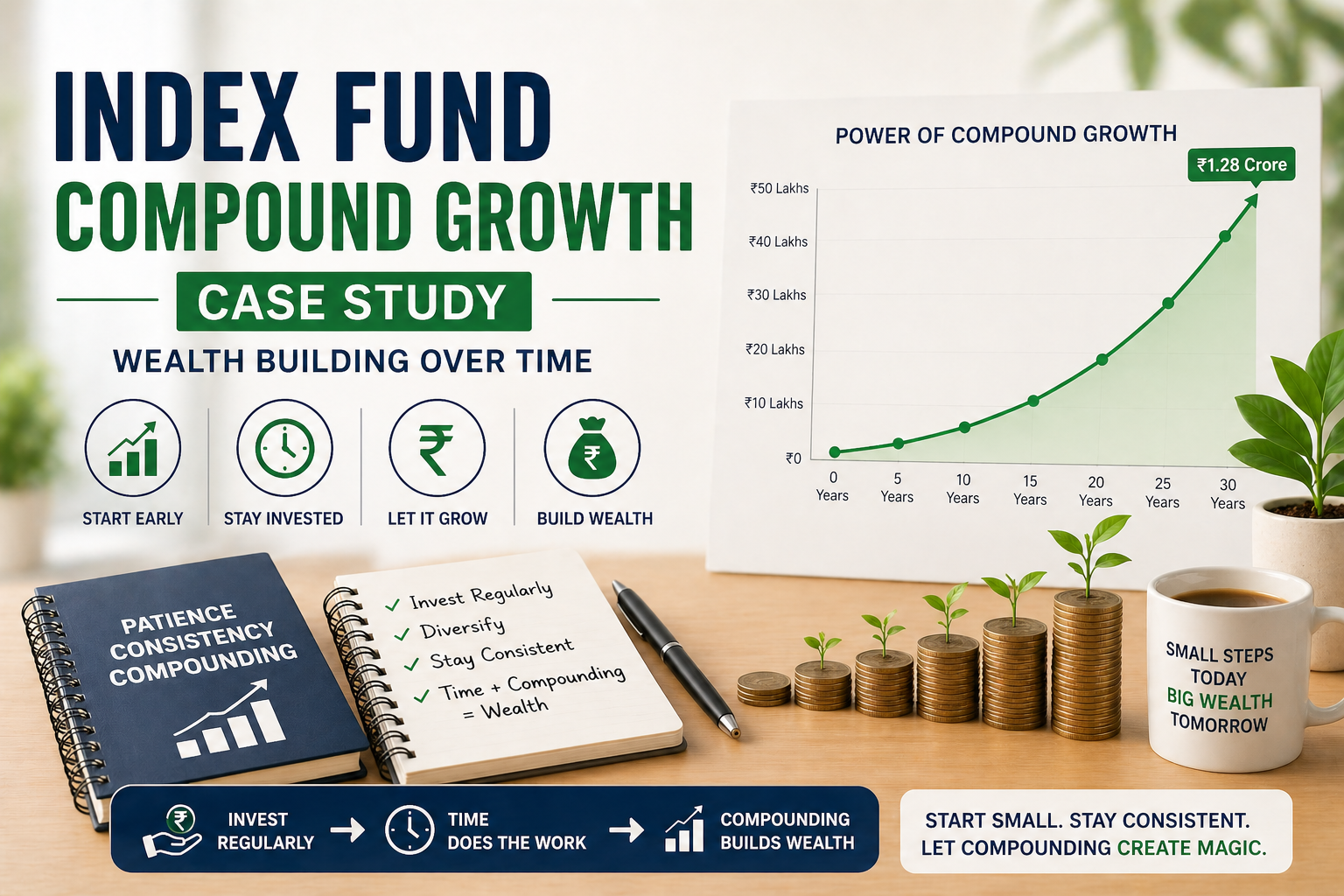
Let us look at a concrete example to understand the true power of index fund investing over time. Meet Marcus, a 25-year-old teacher from Chicago who starts investing $400 per month in an S&P 500 index fund with a 0.03% expense ratio. He assumes a 9% average annual return, consistent with historical S&P 500 averages after adjusting for dividends.
| Year | Total Contributed | Portfolio Value | Gains From Compounding |
|---|---|---|---|
| Year 5 | $24,000 | $29,650 | $5,650 |
| Year 10 | $48,000 | $77,640 | $29,640 |
| Year 15 | $72,000 | $162,380 | $90,380 |
| Year 20 | $96,000 | $301,840 | $205,840 |
| Year 30 | $144,000 | $748,500 | $604,500 |
The numbers are striking. After 30 years of contributing $400 per month — a total personal contribution of $144,000 — Marcus’s portfolio is worth approximately $748,500. Over 80% of his final wealth ($604,500) came from compound growth rather than his own savings. This is the “eighth wonder of the world” as Einstein allegedly described compound interest — and it requires nothing from Marcus except patience and consistency. He crossed the $100,000 milestone around Year 11 without any changes to his strategy.
Crucially, this result does not require investing genius, stock-picking skill, or market timing. It requires only three things: starting early, staying consistent, and choosing a low-cost index fund. You can use our Index Fund Returns Calculator above to run your own personalized projections based on your monthly investment amount and time horizon.
If Marcus had waited just 5 years before starting — beginning at age 30 instead of 25 — his portfolio after 30 years of total investing would be approximately $462,000 instead of $748,500. That 5-year delay cost him over $280,000 in final wealth, despite contributing the same amount per month. The best time to start investing in index funds is today.
🌐 Trusted External Resources
- SEC Investor.gov: Understanding Mutual Funds and ETFs — Official US government guide to index fund investing basics.
- S&P SPIVA Report — Annual data on active vs passive fund performance across global markets.
- Vanguard VOO Fund Profile — Full details on the world’s most popular S&P 500 index fund.
- SEBI India: Guide to Passive Investing — Official SEBI resource on index fund investing for Indian investors.
❓ Frequently Asked Questions
📤 Found this helpful? Share it!
Start Investing in Index Funds Today →
No minimum investment required. Takes less than 15 minutes to get started.