
Start Investing with ₹500/Month in India — 5 Smart Ways to Grow Your Money
“I don’t earn enough to invest.” Sound familiar? If you’ve ever said this to yourself — or thought it quietly while watching your salary disappear between rent, groceries, and EMIs — you’re not alone. Millions of Indian salaried employees feel exactly the same way. But here’s the truth most people never hear: you don’t need ₹10,000 or even ₹5,000 to start. You can genuinely start investing 500 rupees India — every single month — and build real, meaningful wealth over time.
In this guide, we’ll walk you through five practical, beginner-friendly investment options that accept as little as ₹500 a month. We’ll share a real relatable Indian story, bust common myths, and give you a free interactive SIP calculator to see exactly what your ₹500 can become.

Meet Ram— The ₹500 That Changed Everything
Meet Ram, a 27-year-old junior accountant from Nagpur who takes home about ₹22,000 a month after tax. Between her PG rent, home grocery contributions, and daily travel costs, he was left with barely ₹3,000–₹4,000 at month-end. Investing felt like a luxury meant for higher earners.
One evening, a colleague casually mentioned he had started a SIP — a Systematic Investment Plan (an automatic monthly deposit into a mutual fund) — for just ₹500 using the Groww app. Curious, Ram tried it herself. Within 10 minutes he had an account, completed eKYC digitally using her Aadhaar, and set up a ₹500 monthly SIP in a Nifty 50 index fund.
Two years later, he had invested ₹12,000 in total. Her portfolio value? Around ₹14,200 — roughly an 18% return. Far better than any savings account. More importantly, he finally feels like an investor. he has since increased her SIP to ₹2,000 a month.
Why ₹500 Is Actually a Powerful Start (Not a Joke)
Most people underestimate what small, consistent investments can do over time. It comes down to compounding — your returns start earning their own returns. Below is a simple look at what ₹500 per month can grow into at a 12% average annual return (a reasonable long-term estimate for equity mutual funds tracked on the NSE India index):
| Investment Period | Total Invested | Estimated Value | Wealth Gained |
|---|---|---|---|
| 5 Years | ₹30,000 | ₹41,000 | ₹11,000 |
| 10 Years | ₹60,000 | ₹1,16,000 | ₹56,000 |
| 20 Years | ₹1,20,000 | ₹4,99,000 | ₹3,79,000 |
| 30 Years | ₹1,80,000 | ₹17,64,000 | ₹15,84,000 |
Yes — ₹500 a month for 30 years can become over ₹17 lakhs. That is the power of starting early, even with a tiny amount.
5 Best Ways to Start Investing 500 Rupees India Every Month
Let’s break down each option clearly — what it is, how to start, and what to realistically expect.
1. Mutual Fund SIP — Best Option for Small Investment India Monthly

A SIP (Systematic Investment Plan) is the simplest way to invest in mutual funds. You set up an auto-debit of ₹500 from your bank every month, and it automatically buys units in a mutual fund. A mutual fund is a pool of money from many investors, managed professionally and invested in stocks, bonds, or other assets.
- Minimum SIP: ₹500/month (some funds allow ₹100)
- Where to start: Groww, Zerodha Coin, Paytm Money, or directly via AMC websites
- Regulated by: SEBI (Securities and Exchange Board of India)
- Best for: Long-term wealth creation (5+ years)
- Suggested fund for beginners: Nifty 50 Index Fund or a large-cap fund
2. Recurring Deposit (RD) — Risk-Free for Total Beginners
A Recurring Deposit (RD) is offered by almost every Indian bank — SBI, HDFC, ICICI, Bank of Baroda — and even Post Offices. You deposit a fixed amount every month and earn guaranteed interest. There is zero market risk.
- Minimum amount: ₹100–₹500/month depending on the bank
- Current interest rate: ~6.5–7.5% per annum (as of 2024–25)
- Tenure: 6 months to 10 years
- Risk: Zero — returns are guaranteed
3. Public Provident Fund (PPF) — Tax-Free and Government-Backed
The Public Provident Fund (PPF) is one of India’s most trusted investment options. It is backed by the Government of India, regulated by the Ministry of Finance, and your returns are completely tax-free under Section 80C of the Income Tax Act.
- Minimum deposit: ₹500/year (you can do ₹500/month = ₹6,000/year)
- Maximum deposit: ₹1.5 lakh/year
- Interest rate: ~7.1% per annum (reviewed quarterly by the Government)
- Lock-in period: 15 years (partial withdrawal allowed after year 7)
- Tax benefit: Investment, interest, and maturity — all tax-free (EEE status)
4. Digital Gold — Invest in Gold from Just ₹1
Digital Gold lets you buy fractions of 24-karat gold online — no jewellery, no bank locker needed. The physical gold is stored in secure vaults on your behalf. You can start from as little as ₹1, making it one of the most accessible investing for beginners India options available today.
- Platforms: Paytm, PhonePe, Google Pay, Groww — all offer Digital Gold
- Minimum buy: ₹1 or equivalent weight in grams
- Returns: Linked to live market gold prices — can go up or down
- Conversion: Can be converted to physical gold coins once enough is accumulated
5. NPS (National Pension System) — Build Your Retirement with ₹500
The National Pension System (NPS) is a government-backed retirement savings scheme. For salaried employees thinking about how to invest with low income India, NPS offers an additional tax deduction of up to ₹50,000 under Section 80CCD(1B) — over and above the standard ₹1.5 lakh Section 80C limit.
- Minimum contribution: ₹500/month (Tier-I account)
- Returns: 8–10% historically (mix of equity and debt)
- Tax benefit: Up to ₹2 lakh total deduction per year
- Where to open: eNPS portal, SBI, HDFC, ICICI, or through your employer
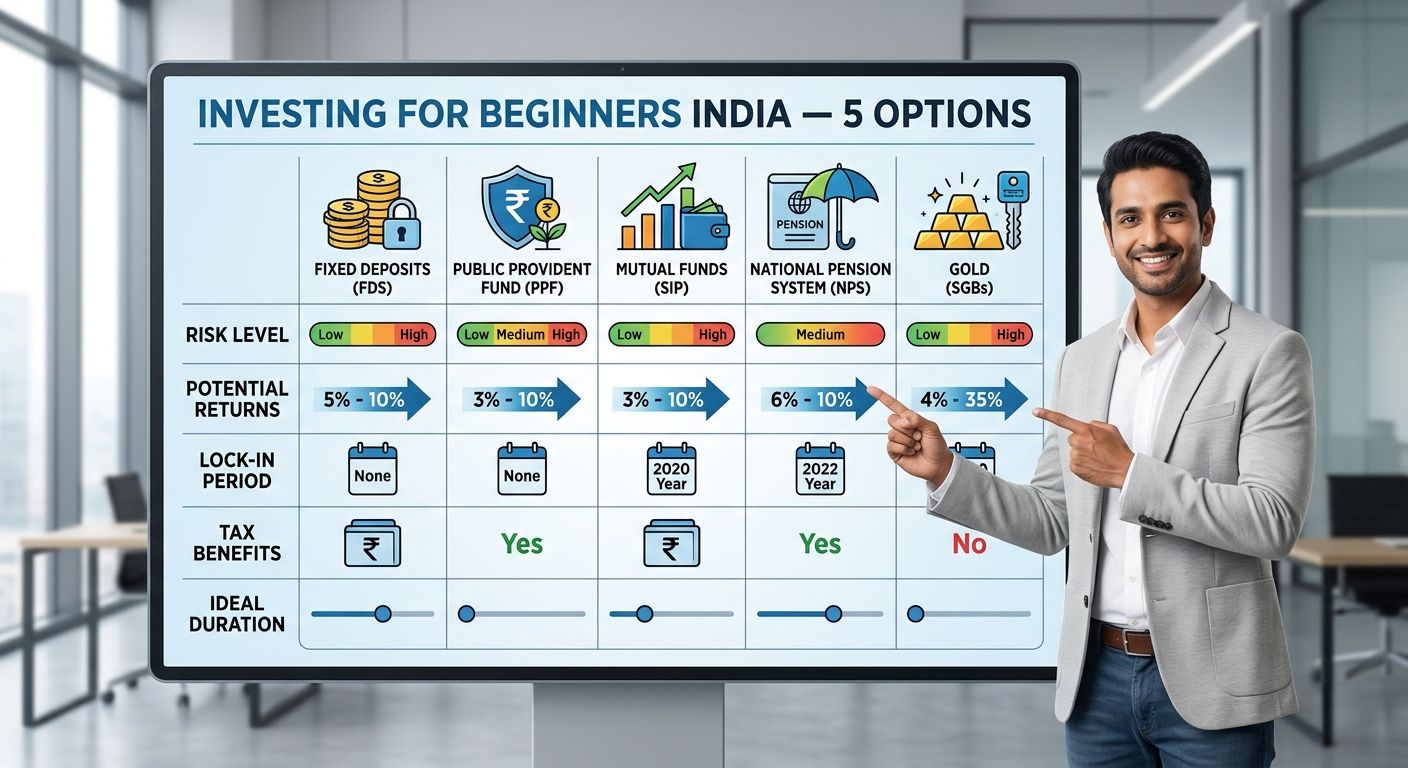
Quick Comparison: Which ₹500 Investment Option Is Right for You?
| Option | Risk | Expected Return | Tax Benefit | Best For |
|---|---|---|---|---|
| Mutual Fund SIP | Medium–High | 10–14% | ELSS: 80C | Long-term wealth |
| Recurring Deposit | Zero | 6.5–7.5% | None | Short-term goals |
| PPF | Zero | ~7.1% | 80C (EEE) | Tax saving + safety |
| Digital Gold | Medium | Varies with gold price | None | Diversification |
| NPS | Low–Medium | 8–10% | 80CCD (extra ₹50K) | Retirement planning |
Free SIP Growth Calculator — See What Your ₹500 Can Become
Enter your monthly SIP amount, expected annual return, and investment period to see your estimated wealth instantly.
📈 SIP Growth Calculator
How to Actually Get Started Today — Step by Step
Getting started takes less than 15 minutes if you have your Aadhaar and PAN ready. Here is the exact process for starting a mutual fund SIP — the most recommended option for long-term beginners:
- Step 1 — Get your PAN and Aadhaar ready. These are mandatory for KYC (Know Your Customer) verification in India.
- Step 2 — Download Groww, Zerodha Coin, or Paytm Money. All are SEBI-regulated and completely free to use.
- Step 3 — Complete eKYC online. Takes 5–10 minutes using your Aadhaar OTP. No physical documents or branch visit needed.
- Step 4 — Choose your first fund. Search for a “Nifty 50 Index Fund” and pick one with a low expense ratio (aim for under 0.5%).
- Step 5 — Set up a ₹500 monthly SIP. Link your bank account and choose a debit date (1st or 5th of the month works well).
- Step 6 — Don’t touch it. Let it run. Review once every 6 months. Increase the SIP amount whenever your salary allows.
3 Common Myths About Investing With a Small Salary in India
Myth 1: “I Need at Least ₹10,000 to Start Investing”
Reality: You can start a SIP with ₹500, buy digital gold for ₹1, and open a PPF for ₹500 a year. The barrier to entry has never been lower. What you actually need is the decision to begin.
Myth 2: “Mutual Funds Are Only for Rich People or Experts”
Reality: Mutual funds are regulated by SEBI specifically to make investing accessible to everyone. Index funds require zero expertise — they automatically mirror the performance of the top 50 or 100 companies on the NSE/BSE.
Myth 3: “My Savings Account Is Good Enough”
Reality: Most Indian savings accounts offer 2.7%–4% interest. India’s average inflation runs at 5%–6% per year. This means money sitting in a savings account is losing real value every year. Investing is how you protect and grow your money against inflation.
📚 Continue Reading on Life in Finance:

Key Takeaways — Start Investing 500 Rupees India Today
- ✅ You don’t need a high salary to invest — ₹500/month is more than enough to start
- ✅ For long-term wealth, a Nifty 50 Index Fund SIP is the simplest and most powerful option
- ✅ For safety and tax savings, PPF and NPS are excellent government-backed choices
- ✅ Start as early as possible — compounding rewards time more than amount
- ✅ Always invest through SEBI-regulated platforms — Groww, Zerodha, Paytm Money are all safe
- ✅ Automate your SIP so you never have to rely on willpower every month
Remember Ram from Nagpur? he didn’t wait for her salary to double. he started with ₹500, and that one small step completely changed her relationship with money. You can do the same — starting right now.
Frequently Asked Questions
Can I really start investing with just ₹500 in India?
Yes, absolutely. Many mutual fund SIPs allow you to start with as little as ₹500 per month. Platforms like Groww, Zerodha Coin, and Paytm Money make it easy to set up in under 15 minutes with just your Aadhaar and PAN. You can also buy digital gold for as little as ₹1.
Which is the best investment option for ₹500 per month in India?
For long-term wealth building, a Mutual Fund SIP in a Nifty 50 Index Fund is widely considered the best starting point. For zero risk and tax benefits, PPF is excellent. For retirement savings, NPS offers an additional tax deduction of up to ₹50,000 per year.
Is SIP safe for beginners in India?
SIPs are regulated by SEBI and are a well-established investment method. While mutual funds carry market risk, SIPs reduce it through rupee cost averaging — you buy more units when prices fall. For beginners, Nifty 50 index funds are the safest and simplest option.
How much can ₹500/month grow in 10 years?
At an assumed 12% annual return, ₹500 invested monthly for 10 years grows to approximately ₹1.16 lakh from just ₹60,000 invested. Use the SIP calculator above to personalise this estimate for your own goals.
What documents do I need to start investing in India?
You need a PAN card, Aadhaar card, a savings bank account, and your mobile number linked to Aadhaar for OTP verification. The entire eKYC process is digital and takes just 5–10 minutes on most platforms.
Can I invest ₹500/month in PPF?
The minimum annual deposit for PPF is ₹500 per financial year. You can choose to contribute monthly (₹500 × 12 = ₹6,000/year). PPF accounts can be opened at SBI, nationalised banks, or Post Offices and managed fully online.
Is digital gold a good investment for beginners in India?
Digital gold is accessible but should make up only a small portion of your portfolio (5–10%). Returns depend on gold prices, which can be volatile. SEBI-regulated Gold ETFs through a demat account are often a better alternative to app-based digital gold platforms.
if (num >= 10000000) { return ‘₹’ + (num / 10000000).toFixed(2) + ‘ crore’; }
if (num >= 100000) { return ‘₹’ + (num / 100000).toFixed(2) + ‘ lakh’; }
return ‘₹’ + num.toLocaleString(‘en-IN’); }
function calculateSIP() { var amountInput = document.getElementById(‘sip-amount’); var rateInput = document.getElementById(‘sip-rate’); var yearsInput = document.getElementById(‘sip-years’); var box = document.getElementById(‘sip-result’);
if (!amountInput || !rateInput || !yearsInput || !box) return;
var P = parseFloat(amountInput.value); var annualRate = parseFloat(rateInput.value); var years = parseFloat(yearsInput.value);
if (isNaN(P) || isNaN(annualRate) || isNaN(years) || P <= 0 || annualRate <= 0 || years <= 0) { box.style.display = 'block'; box.innerHTML = '⚠️ Please enter valid positive numbers in all fields.‘; return; }
var r = annualRate / 12 / 100; var n = years * 12; var fv = P * ((Math.pow(1 + r, n) – 1) / r) * (1 + r); var inv = P * n; var gained = fv – inv;
box.style.display = ‘block’; box.innerHTML = ‘Here's What Your SIP Can Grow To:
‘ +
‘💰 Total Amount Invested: ₹’ + inv.toLocaleString(‘en-IN’) + ‘
‘ +
‘📈 Estimated Future Value: ‘ + formatIndian(fv) + ‘
‘ +
‘🎉 Wealth Gained (Profit): ‘ + formatIndian(gained) + ‘
‘ + ‘* Estimates based on a constant annual return. Actual mutual fund returns vary with market conditions.‘; }
window.addEventListener(‘DOMContentLoaded’, function () { var btn = document.getElementById(‘sip-calc-btn’); var amountInput = document.getElementById(‘sip-amount’); var rateInput = document.getElementById(‘sip-rate’); var yearsInput = document.getElementById(‘sip-years’);
if (btn) { btn.addEventListener(‘click’, calculateSIP); }
[amountInput, rateInput, yearsInput].forEach(function (el) {
if (!el) return;
el.addEventListener(‘input’, function () {
var box = document.getElementById(‘sip-result’);
if (box && box.style.display === ‘block’) {
calculateSIP();
}
});
});
});
})();