
50 30 20 Budget Rule India: The Only Salary Guide You Need in 2024
Ever reached the 20th of the month and wondered where your entire salary disappeared? You are definitely not alone. Most Indian salaried employees earn a decent income but struggle to make it work properly. The good news? The 50 30 20 budget rule India is a beautifully simple framework that can completely change how your money behaves — no spreadsheets, no financial degree needed.
In this post, we’ll break down exactly how this rule works for Indian salaries, show you real numbers, and even help you calculate your own split — all in under 10 minutes.

What Is the 50 30 20 Budget Rule?
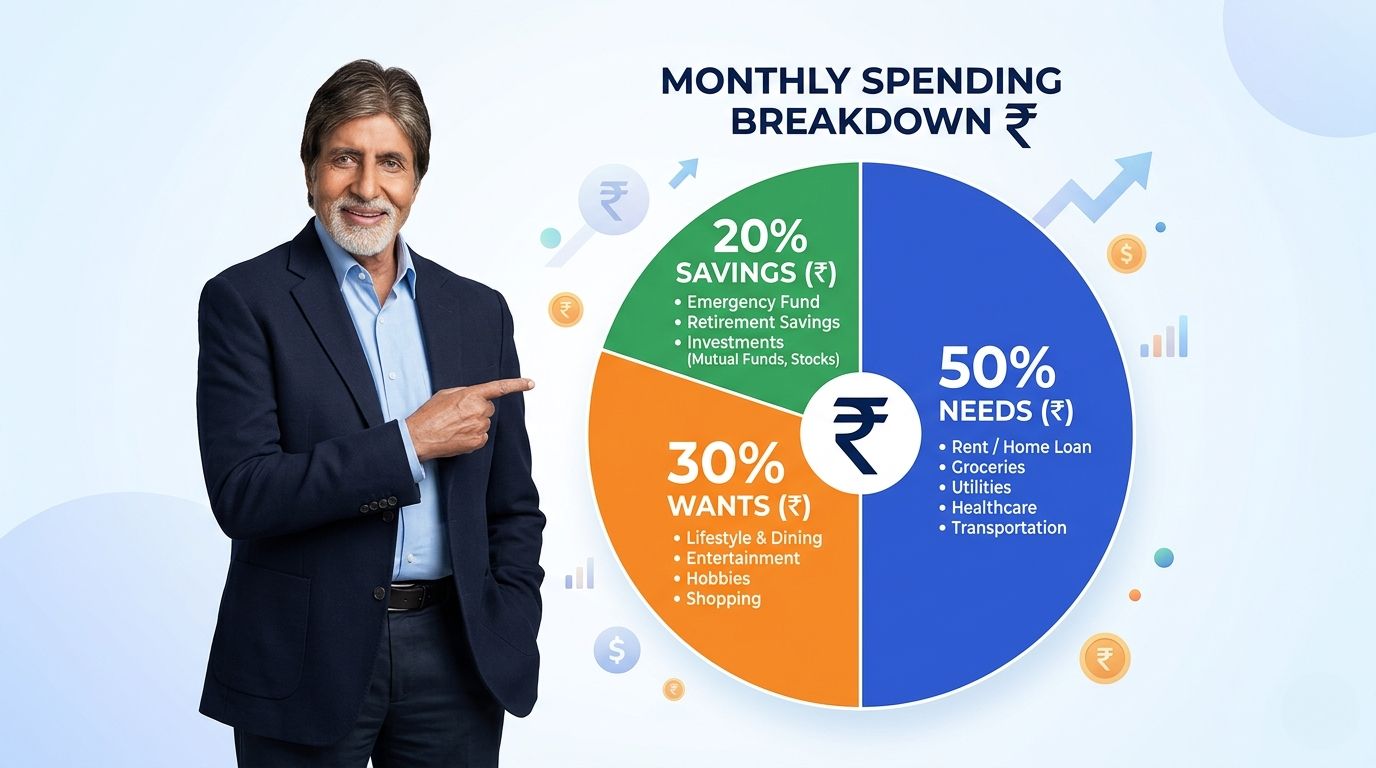
The 50 30 20 rule is a personal budgeting method popularised by US Senator Elizabeth Warren in her book All Your Worth. The idea is simple: divide your take-home salary (that’s the amount credited to your bank account after TDS deductions — Tax Deducted at Source, which is the tax your employer cuts before paying you) into three buckets:
- 50% → Needs — rent, groceries, EMIs, utilities, school fees
- 30% → Wants — dining out, subscriptions, shopping, travel
- 20% → Savings & Investments — SIPs, PPF, emergency fund, RD
That’s it. Three numbers. One straightforward rule. No 47-line Excel sheet required.
A Real Indian Story: Meet Deepak from Jaipur
Meet Deepak, a 34-year-old government bank employee from Jaipur working with Bank of Baroda. He draws a comfortable in-hand salary of ₹52,000 per month — decent by Jaipur standards — yet every year-end, he had nothing meaningful to show for it. No investments, no emergency fund, just a savings account balance that barely crossed ₹15,000 before vanishing again.
His problem was not the salary. It was the invisible leaks. A ₹4,500 credit card bill from a random shopping spree on Myntra. Weekend trips to the Aravalli hills with friends — “just ₹3,000 each time” — adding up to ₹12,000 a month without him realising. Festival gifting, eating out twice a week at local dhabas and restaurants, and an impulsive upgrade to the latest OnePlus phone on no-cost EMI (which, of course, quietly became a monthly “need”).
A colleague handed him a printout explaining the 50 30 20 budget rule India version adapted for salaried employees. Deepak did a quick audit of his last three months’ UPI transactions on PhonePe. The results were uncomfortable — he was spending nearly 62% on needs, 35% on wants, and a painful 3% on savings. That 3% was going straight into a savings account earning 3.5% interest — barely beating inflation.
He made three changes, and only three. First, he cancelled two OTT subscriptions he barely used and cut dining out from five times a week to twice. Second, he set a standing instruction at his bank so that ₹10,400 (exactly 20% of his salary) auto-transferred to a separate ICICI zero-balance account every 1st of the month — before he could spend it. Third, he started a ₹7,000 monthly SIP in a Nifty 50 index fund and parked the remaining ₹3,400 in an SBI liquid fund as the start of his emergency corpus.
Ten months later, Deepak had ₹72,000 in mutual funds and ₹34,000 in his liquid fund. He had not sacrificed his lifestyle dramatically — he still took weekend trips, still ate out, still enjoyed his phone. He had simply given every rupee a job before it could disappear. Same Jaipur. Same salary. Completely different financial story.
How to Apply the 50 30 20 Rule to Indian Salary: Real Numbers
Let’s make this concrete with three common Indian salary levels — ₹30,000, ₹60,000, and ₹1,00,000 in-hand per month:
| In-Hand Salary | 50% Needs | 30% Wants | 20% Savings |
|---|---|---|---|
| ₹30,000 | ₹15,000 | ₹9,000 | ₹6,000 |
| ₹50,000 | ₹25,000 | ₹15,000 | ₹10,000 |
| ₹75,000 | ₹37,500 | ₹22,500 | ₹15,000 |
| ₹1,00,000 | ₹50,000 | ₹30,000 | ₹20,000 |
| ₹1,50,000 | ₹75,000 | ₹45,000 | ₹30,000 |
What Goes in the “Needs” (50%) Bucket?
Needs are expenses you cannot skip without serious consequences. Think of them as the costs of simply existing and functioning. For most Indian salaried employees, this includes:
- Rent or home loan EMI
- Groceries and household essentials
- Electricity, gas, water, and internet bills
- Commute costs (metro, petrol, auto)
- Children’s school fees
- Health insurance premiums
- Minimum loan EMIs (car, personal loan)
What Goes in the “Wants” (30%) Bucket?
Wants are things that make life enjoyable but that you could cut if you had to. This is where most Indians unknowingly overspend. Common wants include:
- Eating out and food delivery (Zomato, Swiggy)
- Weekend trips and holidays
- Streaming subscriptions (Netflix, Prime, Hotstar)
- Gym memberships you may or may not use
- Clothes, gadgets, and non-essential shopping
- Socialising and entertainment
What Goes in the “Savings” (20%) Bucket?
This is the bucket that builds your future. As a 50 30 20 rule salaried employee in India, your 20% should be split smartly:
- Emergency fund first — build 3–6 months of expenses in a liquid FD or savings account
- SIP in mutual funds — SEBI-registered mutual funds via Groww, Zerodha Coin, or HDFC Sky
- PPF (Public Provident Fund) — government-backed, tax-free returns over 15 years
- NPS (National Pension System) — for retirement, with additional tax benefits under Section 80CCD(1B)
- Recurring Deposits (RD) at SBI or any bank for short-term goals
Adapting the 50 30 20 Rule for Indian Realities
Here’s something most budget guides won’t tell you: the original 50 30 20 rule was designed for the US cost of living. India is different, and the budgeting rule India salary context requires some honest adjustments.
Indian-Specific Adjustments to Consider
| Situation | Suggested Adjustment |
|---|---|
| High-rent metro (Mumbai, Bengaluru) | Try 60-25-15 initially, move toward 50-30-20 over time |
| Living with parents (no rent) | Shift extra to savings — try 40-25-35 |
| Sending money home (family support) | Count remittances as a “Need”, not a want |
| Multiple loan EMIs | Aggressively cut wants to clear high-interest debt first |
| Tier 2 / Tier 3 city (lower costs) | Needs may naturally be 35-40%; boost savings to 25-30% |
How to Budget Salary India: 5 Steps to Start This Weekend
Knowing the rule and actually using it are two different things. Here is a practical step-by-step plan to implement the how to budget salary India approach starting right now:
Step 1 — Know your actual in-hand salary
Check your last salary slip or bank credit message. Use only the amount credited to your bank — not your CTC. Your employer’s PF contribution and gratuity do not count here.
Step 2 — List every rupee you spend in a month
Go through your bank statement and UPI history on PhonePe or Google Pay. Categorise each expense as a Need or a Want. Be honest — that daily Starbucks is a Want, not a Need.
Step 3 — Compare your current split to 50-30-20
Add up your Needs. Add up your Wants. Whatever is left (hopefully something!) is your current savings rate. See how far off you are from the 50-30-20 target.
Step 4 — Set up automatic transfers on salary day
The single most powerful thing you can do: on the day your salary arrives, automatically move 20% into a separate savings/investment account. Use SBI’s standing instructions, HDFC auto-sweep, or a SIP date aligned to your salary date. Pay yourself first — then spend what is left.
Step 5 — Review every month and tweak gently
Spend 15 minutes at month-end looking at your numbers. You don’t need perfection — you need progress. Even moving from 5% savings to 12% in six months is a massive win.
Common Mistakes Indian Salaried Employees Make with the 50 30 20 Rule
A lot of people try the 50 30 20 rule and give up after two months. Here’s why — and how to avoid falling into the same traps:
| Common Mistake | What to Do Instead |
|---|---|
| Using CTC instead of in-hand salary | Always use the amount credited to your bank account |
| Treating credit card bills as “future you’s problem” | Include full credit card outstanding in your Wants or Needs bucket |
| Saving what’s left after spending | Save first, spend what remains — automate on salary day |
| Counting LIC premium as savings | Traditional LIC endowment plans are insurance + poor returns — check the actual yield before calling it savings |
| Quitting when one month goes wrong | Budgets fail. The goal is the long game — reset and continue next month |

🧮 50 30 20 Budget Planner — Enter Your Salary
Is the 50 30 20 Rule the Best Budget Method for Indians?
The 50 30 20 rule is not perfect — no single framework is. But it has some clear advantages over other popular methods, especially for Indian salaried employees who want simplicity without sacrificing discipline:
| Method | Complexity | Best For |
|---|---|---|
| 50-30-20 Rule | Very Simple | Beginners, salaried employees wanting quick structure |
| Zero-Based Budget | High | Detail-oriented people, those with variable expenses |
| Pay Yourself First | Simple | High earners who want to maximise savings rate |
| Envelope System | Medium | Cash-heavy spenders or those who overshoot categories |
For most Indian salaried employees — especially those just starting their financial journey — the 50 30 20 rule salaried employee approach wins on simplicity and sustainability. The best budget is the one you will actually stick to, and three buckets are a lot easier to track than 47 expense categories.
Frequently Asked Questions
What is the 50 30 20 budget rule in India?
The 50 30 20 budget rule India approach divides your in-hand monthly salary into three parts: 50% for needs (rent, groceries, EMIs), 30% for wants (dining out, entertainment, shopping), and 20% for savings and investments. It is one of the simplest personal budgeting frameworks for Indian salaried employees.
Should I apply the 50 30 20 rule to my CTC or in-hand salary?
Always apply it to your in-hand salary — the amount credited to your bank after TDS and PF deductions. Your CTC includes components like employer PF and gratuity that you never directly receive as spendable cash.
Is the 50 30 20 rule realistic in Mumbai or Bengaluru?
In high-rent metros, keeping needs under 50% can be challenging. A modified split like 60-25-15 is fine to start with. The goal is to gradually work towards 50-30-20 as your income grows or costs reduce. Progress matters more than perfection.
What should I invest in for the 20% savings portion?
Build an emergency fund first (3-6 months of expenses in a liquid FD), then start SIPs in SEBI-registered mutual funds via platforms like Zerodha Coin or Groww. PPF, NPS, and RDs at SBI are also excellent options based on your goals.
Can I follow the 50 30 20 rule on a ₹25,000 salary?
Yes — on ₹25,000 in-hand, you would target ₹12,500 for needs, ₹7,500 for wants, and ₹5,000 for savings. In a low-cost city or if you live with family, this is very achievable. Even a ₹3,000 monthly SIP is a meaningful start.
Is money sent home to parents a Need or a Want?
If supporting parents is a regular, non-negotiable commitment, count it as a Need within your 50% bucket. If it is occasional or discretionary, place it in Wants. Many Indian salaried employees support family — simply adjust and aim to grow your income over time.
How is the 50 30 20 rule different from zero-based budgeting?
The 50 30 20 rule uses three broad buckets and is very simple to maintain. Zero-based budgeting requires assigning a purpose to every single rupee — far more detailed and time-consuming. For most people using the budgeting rule India salary framework, 50-30-20 is easier to sustain over the long run.
The 50 30 20 budget rule India is not magic — it’s a mirror. It shows you exactly where your money is going and gives you a clear, actionable framework to redirect it. Whether you earn ₹25,000 or ₹2,50,000 a month, three buckets are all you need to start building the financial life you want. The best time to start was last month. The second-best time is right now.
Explore More Personal Finance Guides →